
Emergency Gate Repair Near Me: What Yorba Linda Homeowners Should Do First
If your gate is stuck right now, stop forcing it. A gate that won’t move is usually in fault-hold, not mechanically jammed, and the single most expensive mistake we see is a homeowner pushing or pulling a motorized gate through that resistance. The correct first step is to identify which failure you’re dealing with, disengage the operator if safe to do so, and secure the opening before you call for gate repair. We answer 24/7. Fast dispatch from 7am to 7pm, Sunday through Friday.
If you’d rather not sort this out yourself, call (855) 382-4716 and we’ll walk you through what you’re seeing. But if you want to understand what’s happening before you pick up the phone, here’s the sequence that prevents a small repair from becoming a full operator replacement.
Key Takeaways
- Never force a gate that’s stopped mid-travel. It’s often in fault-hold, and forcing it strips gears or bends track.
- Slide gates and swing gates disengage differently. The emergency release is your first tool.
- A gate stuck open is a security problem. A gate stuck closed is a safety and access problem. Handle them differently.
- Three failure types exist: motor fault, sensor fault, mechanical jam. The right action depends on which one you have.
- What you tell the phone tech determines whether the first visit is a fix or just a diagnosis.
Why Yorba Linda Gates Fail Suddenly
Most emergency calls we take in Yorba Linda follow the same pattern. The gate worked fine yesterday. Today it won’t move, or it moved six inches and stopped. Homeowners in this area live on lots where the gate sees daily cycles, sometimes twenty or more per day for busy households. Every cycle works the hinges, the operator motor, the limit switches, and the safety sensors. Eventually something lets go.
The mild inland climate here doesn’t punish gates the way extreme weather does, but it does create its own wear pattern. Dust and fine debris from landscaped yards settle into operator housings. Sprinkler overspray corrodes limit switch contacts over time. And the long dry season means steel track and hinges expand and contract less than they would elsewhere, so when a component fails, it tends to be electronic rather than structural.
What doesn’t fail suddenly, in our experience, is the gate itself. Gates sag, hinges wear, and wheels flatten over months. Sudden failure is almost always the operator, the safety circuit, or a mechanical bind that’s been building quietly. That distinction matters because your first action should be different in each case.
First, Figure Out Which Failure You Have
Before you touch the gate, get eyes on the operator and listen. A gate that’s dead silent when you press the remote, one that hums but doesn’t move, and one that moves a few inches then reverses are three different problems with three different urgency levels.
Silent. The operator has no power or the control board isn’t receiving the remote signal. Check the breaker, then check the disconnect switch mounted near the operator. If both are on and you still get nothing, this is an electric gate repair situation. Don’t keep pressing the remote. Repeated attempts won’t clear a dead board, and if the issue is a shorted wire, you’re not helping.
Hums but doesn’t move. The motor is getting power but the output shaft isn’t turning, or the chain or belt has slipped, or the gear inside has stripped. This is a mechanical or drive failure inside the operator. Continuing to hold the button will burn out the motor windings. Stop after the first hum.
Moves a few inches, then reverses or stops. This is classic fault-hold behavior. The control board detected resistance or a safety sensor trip and locked the gate to prevent damage or injury. The gate isn’t stuck. The board stopped it deliberately. Forcing it now is how a limit switch adjustment turns into a $900 operator replacement.
Once you’ve identified which category you’re in, you can decide whether to disengage the operator and move the gate manually.
How to Disengage a Swing or Slide Gate Operator
Every motorized gate has a manual release. It decouples the gate from the motor so you can move the panel by hand. The catch is that slide gates and swing gates release differently, and the release itself may be locked, stiff, or hidden behind a small access panel.
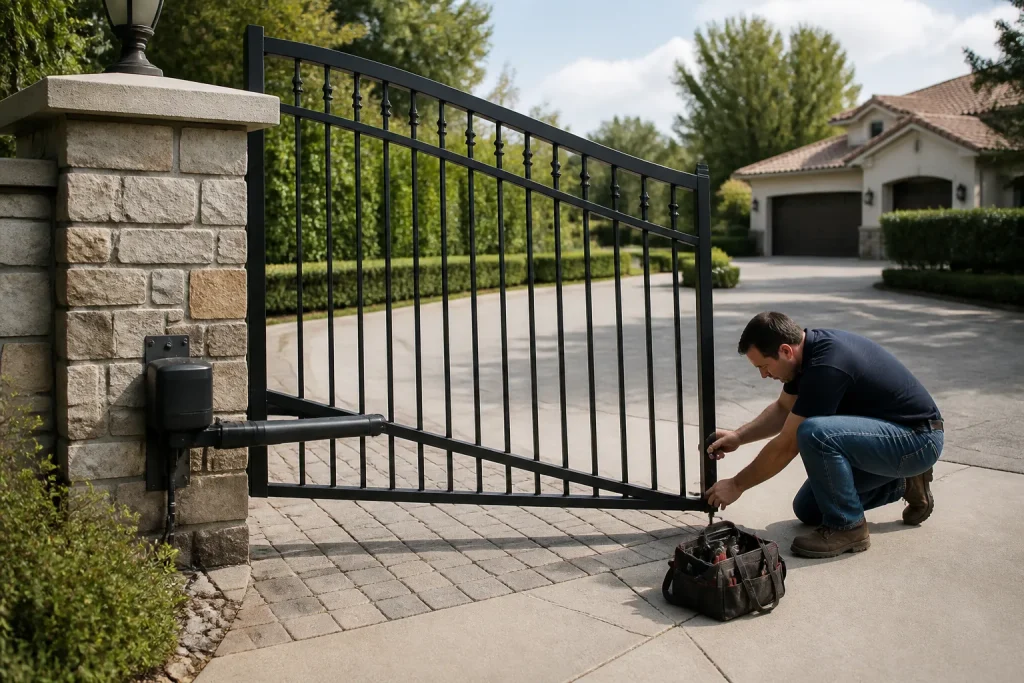
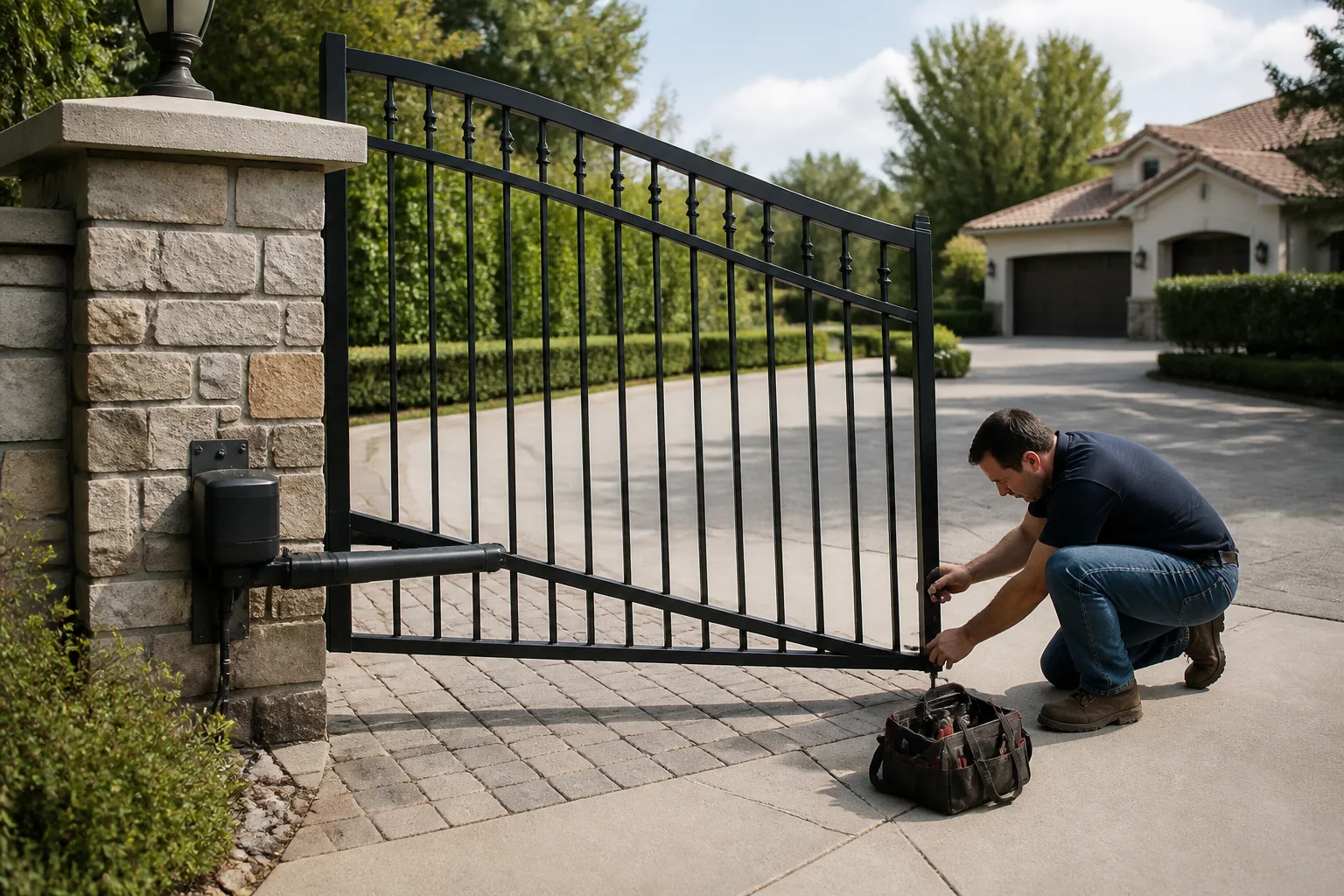
Swing gate operators. Most residential swing operators, including LiftMaster and Mighty Mule units, have a physical release lever or a keyed lock on the side of the operator housing. LiftMaster swing operators typically use a keyed release: turn the key a quarter turn and the arm decouples. Mighty Mule units often have a small metal pin or a release tab. Once released, the gate swings freely by hand. It will be heavy. Move it slowly and keep hands clear of the hinge-side pinch point.
Slide gate operators. Slide operators from brands like Elite and Viking usually have a release lever on the side that lifts the chain or belt tension off the drive sprocket. On Elite operators, the lever is typically a vertical bar you pull up; on Viking units it’s often a T-handle that rotates. Once the chain is free, the gate rolls on its track. Before you roll it, check that nothing has fallen into the track, because a slide gate off its rail is a genuinely dangerous object when it tips.
Forcing either type through a stubborn spot while still engaged is what strips drive gears. If you can’t find the release or it won’t move, leave the gate where it is and call us. We’d rather talk you through it than sell you a new operator you didn’t need.
Gate Stuck Open: What to Do About Security Right Now
A gate that won’t close changes your security posture immediately. In Yorba Linda, most neighborhoods assume a closed gate behind each property. When one stands open, it’s visible from the street, and a driveway leading to a side or rear yard becomes an invitation.
The priority order is physical control, then alarm notification, then documentation.
Physical control. If you can roll or swing the gate manually after releasing the operator, do it. If the gate is open and you can’t move it, block the opening with a vehicle if you have one parked inside. It’s not elegant, but it closes the visual gap. For slide gates that are half open, don’t try to force them past a mechanical bind. Block what’s accessible and call.
Alarm monitoring. If your gate is tied to an access control system or a security panel, call your monitoring company and tell them the gate is offline. Some systems treat a stuck-open gate as a bypass condition, which means the rest of the perimeter logic may not arm properly. You want that noted before anything else happens.
Documentation. Most residential insurance policies expect you to take reasonable steps to secure the property if something goes wrong, and they’ll want a record of when the gate failed and when you called for service. A photo of the gate position and a note of the time costs you nothing and matters more than you’d expect if a theft occurs while the opening is exposed.
None of this is about paranoia. It’s about making the property less tempting for the few hours your gate is down.
What to Tell Us When You Call
We answer 24/7. Fast dispatch from 7am to 7pm, Sunday through Friday. The information you give on the phone determines what goes on hand. Most gate brands communicate fault codes through a series of beeps or blinking lights, and if you can read us those codes, the first visit is often a one-trip repair instead of a diagnostic visit followed by a second trip with parts.
Here’s what helps most, in order:
- What the gate is doing right now. Silent, humming, moving a few inches then stopping, or making a grinding noise.
- The operator brand. LiftMaster, Mighty Mule, Elite, FAAC, whichever it is. Brand matters because fault codes are proprietary.
- The gate type and approximate weight. A light aluminum driveway swing gate and a heavy steel slide gate are different jobs. The release procedure is different too.
- Any recent work or changes. A new car, new fence post, irrigation work near the gate, or a power outage in the last few days. Most sudden failures have a trigger.
- What the fault light or display says. If the operator has a small LED display or a series of blinking lights, count the blinks. One blink means something different on a LiftMaster than it does on a Viking.
We work on your brand at Gate Repair Yorba Linda, which means the technician who arrives already knows what those codes mean on your specific operator rather than learning it in your driveway. That matters at repair rates.
A call outside dispatch hours is booked into the next opening, Sunday through Friday, 7am to 7pm. The phone is answered whenever you make it.
What Can’t Wait Until Tomorrow
Some gate failures are annoying. Others are genuinely urgent. The difference comes down to one question: is the gate creating a safety or security exposure, or is it just inconvenient?
Genuinely urgent: same-day repair
- A gate stuck open that cannot be closed manually and leaves a driveway or yard exposed. This is the top-priority call we get.
- A gate that reversed onto a pedestrian or pet, even if no injury occurred. That means the operator has no obstruction force set or the primary safety device has failed. The gate is unsafe to operate and shouldn’t be cycled until it’s checked.
- A slide gate that has come partially off its track and is leaning. A falling slide gate can injure someone. Shut off power to the operator and block the area.
- A wired keypad or exit loop that has stopped working at an HOA or multi-unit property where vehicles are stacked up at the exit. That becomes a resident problem quickly.
Can wait a day or two
- A gate that operates but is slow, noisy, or visibly sagging. That’s wear, not a failure, and it’s already been happening for months.
- A remote that stopped working when spare remotes still do. That’s a programming or transmitter issue, not an emergency.
- A gate that randomly reverses but still completes its cycle most of the time. That’s a sensor or alignment problem and should be fixed soon, but it’s not a tonight job if you can secure the property.
The dividing line is whether a person or a property is exposed. If the answer is yes, call that day. If the gate works but poorly, call before it becomes an emergency on a morning when you have somewhere to be.
What a Typical Emergency Visit Involves
Most emergency electric gate repair visits follow a predictable shape. The technician arrives, confirms which failure mode the gate is in, releases the operator, and cycles the gate manually to feel for mechanical drag. If the gate moves freely by hand, the problem is in the operator or the controls, not the gate. If it drags or binds manually, the problem is mechanical and the operator may simply have been fighting a hinge or a track issue.
From there, the brand-specific diagnosis begins. LiftMaster and FAAC operators report faults differently than Mighty Mule units. The technician checks the limit settings, the safety sensor inputs, the battery if present, and the control board for visible component damage. Often the fix is a replacement limit switch, a sensor realignment, or a board reset. Sometimes it’s a stripped gear or a failed motor. The estimate is written before any work begins, and the price is per job, set by that written estimate.
We’re gate-only specialists in Yorba Linda. That means the person at your gate has already seen your failure pattern dozens of times on your brand, because gates are all we do. Electric gate repair is one of our core services, and we carry parts and knowledge for the brands most common in this area.
The Bottom Line
When a gate fails suddenly in Yorba Linda, the first move is not to force it. Identify whether you’re dealing with a silent operator, a humming motor, or a fault-hold stop. Release the operator if you can do so safely, secure the opening if the gate is stuck open, and call with the brand name and any fault codes you can see. That sequence keeps a small repair small and gets the gate back in service faster.
If you’re in Yorba Linda and need help right now, Gate Repair Yorba Linda offers free estimates. Call (855) 382-4716. We answer 24/7. Fast dispatch from 7am to 7pm, Sunday through Friday.
Frequently Asked Questions
Emergency gate repair in Yorba Linda is priced per job by the written estimate, not by a flat fee. The cost depends on whether the failure is mechanical, electrical, or a control board issue, and the estimate is free. Call (855) 382-4716 for an exact quote, and the price is agreed before any work starts.
In most cases, yes. We answer 24/7 and dispatch from 7am to 7pm, Sunday through Friday. When you call, tell us the operator brand and what the gate is doing, and we’ll book you into the next available opening. Call (855) 382-4716.
The humming means the motor is getting power but not turning the gate. If you leave it powered and keep pressing the remote, you risk burning out the motor. Shut off power to the operator until a technician can look at it. That’s a same-week fix, and often the parts are already on hand.
LiftMaster swing gate operators use a keyed release on the side of the operator housing. Turn the key and the arm decouples from the motor, letting the gate swing manually. If you can’t locate the release or the key, stop and call us rather than forcing the gate.
Most policies require “reasonable steps” to secure the property, which means documenting the failure, attempting to close or block the gate, and calling for repair promptly. Take a photo of the gate position, note the time, and keep your service call record. That documentation is what most adjusters will ask for.
Written by the team at Gate Repair Yorba Linda.
Need Gate Repair Help?
Call Gate Repair Yorba Linda - licensed & insured, here with fast help in Yorba Linda.
(855) 382-4716